
Choosing between a sole proprietorship and an LLC isn’t just about legal structure—it’s about how much you keep in your pocket after taxes. The sole proprietorship vs LLC tax rates debate boils down to self-employment taxes, deductions, and flexibility. While both pass income through to your personal return, LLCs often offer strategic tax advantages that sole proprietors can’t access. Understanding these differences can mean thousands in annual savings.
How Sole Proprietorship Taxes Work
In a sole proprietorship, your business income is treated as personal income. You report profits and losses on Schedule C of your Form 1040. There’s no separate business tax return—everything flows directly to your individual tax return.
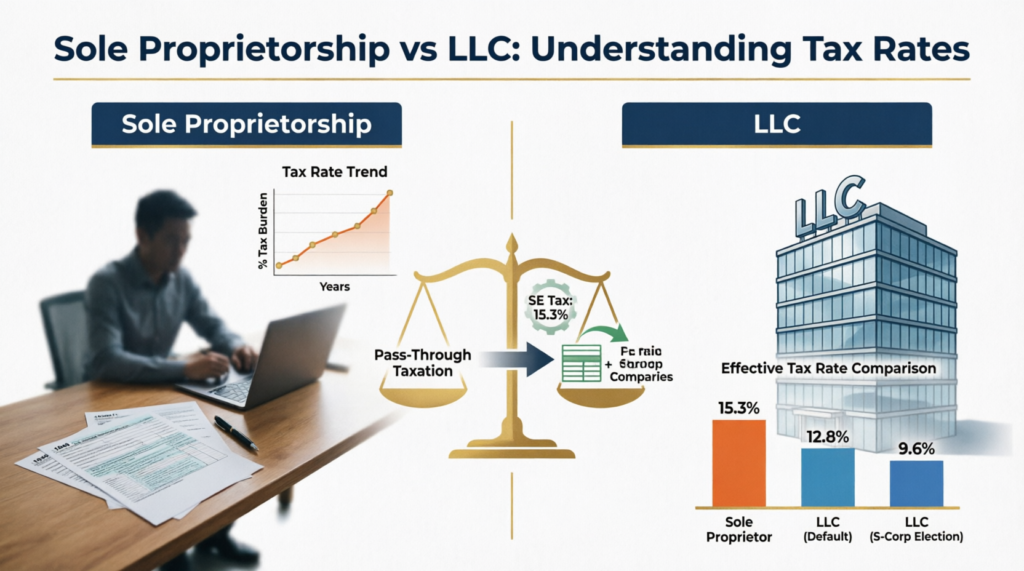
This simplicity comes at a cost. You’re responsible for the full 15.3% self-employment tax (covering Social Security and Medicare) on your net earnings. That’s in addition to regular income tax rates, which can push your effective tax rate well above 30% in high-income years.
- No payroll tax splitting—you pay both employer and employee portions
- All net profit is subject to self-employment tax
- Limited ability to deduct business expenses beyond standard write-offs
LLC Tax Rates: Flexibility and Savings Potential
A single-member LLC is typically taxed as a disregarded entity by default—meaning it reports income like a sole proprietorship. But here’s the key difference: an LLC can elect to be taxed as an S corporation, unlocking major tax savings.
When you elect S corp status, you can pay yourself a reasonable salary (subject to payroll taxes) and take additional profits as distributions—which aren’t subject to self-employment tax. This split can reduce your overall tax burden significantly, especially if your business earns over $60,000 annually.
Example: Tax Savings with S Corp Election
Imagine your LLC earns $100,000 in net profit. As a sole proprietor, you’d pay ~$15,300 in self-employment tax. But as an S corp, you might pay yourself a $50,000 salary (with ~$7,650 in payroll taxes) and take $50,000 as distributions—saving nearly $7,650 in taxes.
Beyond S corp elections, LLCs also offer better liability protection and more credibility with clients—without sacrificing pass-through taxation.
Key Differences in Tax Treatment
While both structures avoid double taxation (unlike C corporations), their treatment of self-employment tax, deductions, and filing requirements differ meaningfully.
- Self-Employment Tax: Sole proprietors pay it on all net income; LLCs can minimize it via S corp election.
- Deductions: LLCs may qualify for more business expense deductions, including home office, health insurance, and retirement contributions.
- Estimated Taxes: Both require quarterly estimated payments, but LLCs with S corp status may have more predictable payroll tax obligations.
- State Taxes: Some states impose franchise or annual fees on LLCs, which don’t apply to sole proprietorships—but these are usually small compared to federal tax savings.
When Does an LLC Make More Sense for Taxes?
An LLC isn’t automatically better—but for growing businesses, the tax advantages often outweigh the extra paperwork. Consider forming an LLC if:
- Your net income exceeds $50,000–$60,000 annually
- You want to reduce self-employment tax liability
- You plan to hire employees or contractors
- You value asset protection alongside tax efficiency
Sole proprietorships remain ideal for low-risk, low-revenue ventures where simplicity trumps optimization. But once your business scales, the LLC structure—especially with S corp taxation—can deliver meaningful savings.
Key Takeaways
- Sole proprietorships are simpler but expose all profits to self-employment tax.
- LLCs offer the same pass-through taxation but allow S corp election to reduce self-employment taxes.
- Tax savings from an LLC with S corp status typically kick in around $60,000 in annual profit.
- Always consult a tax professional before changing your business structure—rules vary by state and income level.
FAQ: Sole Proprietorship vs LLC Tax Rates
Can I avoid self-employment tax entirely with an LLC?
No—but you can reduce it significantly by electing S corporation status and splitting income between salary and distributions. Only the salary portion is subject to payroll taxes.
Do I need to file separate tax returns for an LLC?
Not necessarily. A single-member LLC files taxes like a sole proprietorship (using Schedule C) unless it elects corporate taxation. Multi-member LLCs file Form 1065 but still pass income to members’ personal returns.
Is forming an LLC worth it just for tax savings?
For many, yes—especially if your business earns over $60,000. The potential tax savings often exceed the cost of formation and annual compliance. However, weigh state fees and administrative effort against your specific financial situation.
Choosing the right structure isn’t just about today’s tax bill—it’s about building a foundation that supports long-term growth and financial efficiency. Whether you stay a sole proprietor or upgrade to an LLC, make the decision with your numbers—and your future—in mind.